

For many seniors, the internet is an integral part of maintaining your independence. It connects you to family and friends through email, chat groups and social media. It connects you to the world for news, information, entertainment and services like banking and health services.

One of the most common questions a technology person gets from friends and family is how to select the right internet plan without over-paying? Many are concerned if they select the “most affordable” plans, they would not be able to use bandwidth hungry services like playing videos in social media apps like FaceBook, TikTok or watching their movies on Netflix or videos on YouTube. It is very difficult to make your decision as the top internet vendors like TELUS or Rogers will always steer you towards their most expensive offerings regardless of your actual needs.
COST DIFFERENCE BETWEEN PLANS: regardless of your vendor, there can be a significant spread between their least to most expensive plans of up to $60/month! If you only need the basic plan, savings can add up to $720/year. Click here for the current internet plans for TELUS, Rogers and Bell.
A PENNY SAVED IS A PENNY EARNED! many seniors live on fixed income and any savings are often welcomed. Many of us are often shaped by parents/family before us who lived in the Depression Era, in Canada lasted from 1929 to 1941, have instilled a culture to live within your means and not make any unnecessary purchases unless absolutely needed. This article will steer you to the most appropriate plans and give you a sense you really aren’t missing out on services while hopefully keeping more of your hard earned money in your pocket. Assuming you can save $720/year by selecting the lowest-tier from the highest-tier internet plan.
Potential yearly savings can be significant. Who would say no to 120 cups of premium Starbucks ($6/cup), 360 cups of Tim’s ($2/cup) or up to 480 cups of McDonald’s ($1.50/cup) of coffee? If coffee is not your thing, it can translate into a purchase of a new computer or whatever you want to purchase with this windfall!

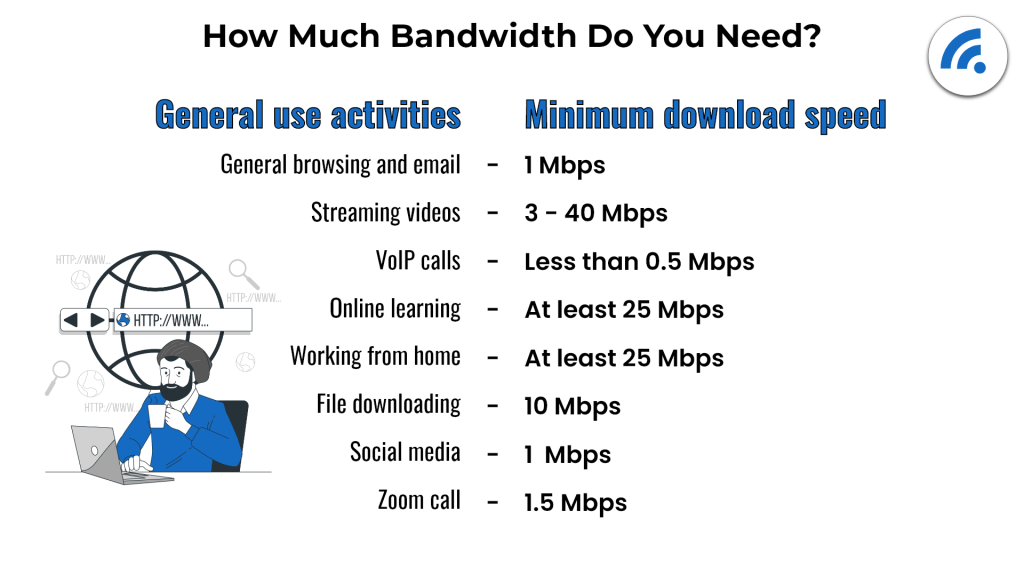
WHAT IS INTERNET SPEED AND BANDWIDTH? For simplicity, we’ll assume internet speed and bandwidth are the same. In very simple terms, it is the amount of data that can be transmitted over an internet connection in a given time. A common measurement is megabits per second (Mbps) which is how vendors list in their internet service tiers. The Broadband Search site has some excellent information on the differentiation of internet speed and bandwidth of which the following graphic on bandwidth is presented.
WHAT ARE MY NEEDS? Before selecting a plan, you will need to understand your needs. That is how many people live in the residence including occasional guests, what internet services will they consume and how much bandwidth in total is needed.
- How Many Individuals?: at any specific point in time, determine how many individuals will be under you internet plan. It can range from individuals, spouses/partners, guests like family and friends. Most seniors will have anywhere from 1 to 5.
- Types of Activities? Browsing, email, social media and video streaming are your typical choices.
- Number of Devices? Each connected device will consume bandwidth.
- Concurrent Usage? What is worst case scenario for bandwidth? That is, will everyone be downloading large files all the time? For most senior’s residences, this number will not exceed 2-3 unless there are a large number of guests.
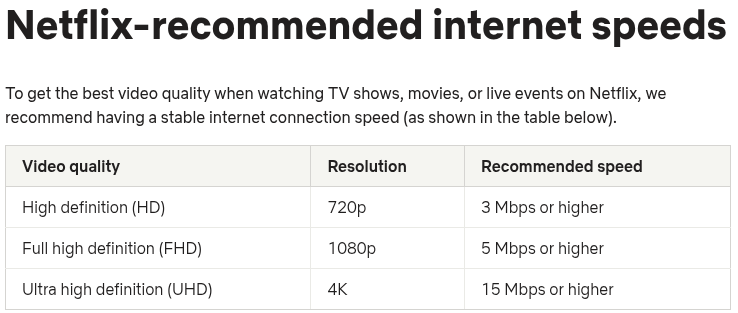
WHICH PLAN TO SELECT DEPENDS ON YOUR INTERNET USAGE? Generally, you need to determine your maximum bandwidth per person. This is typically your highest service and is always video streaming. According to Netflix , their recommended internet streaming requirements for Ultra High Definition (UHD) 15 Mbps or higher so let’s settle on 25 Mbps for our calculations for good measure.
HOW MUCH BANDWIDTH IS NEEDED? Well, it’s not an exact science but generally but my rule of thumb is:
(HOUSEHOLD USERS + 1 ) X 25 Mbps
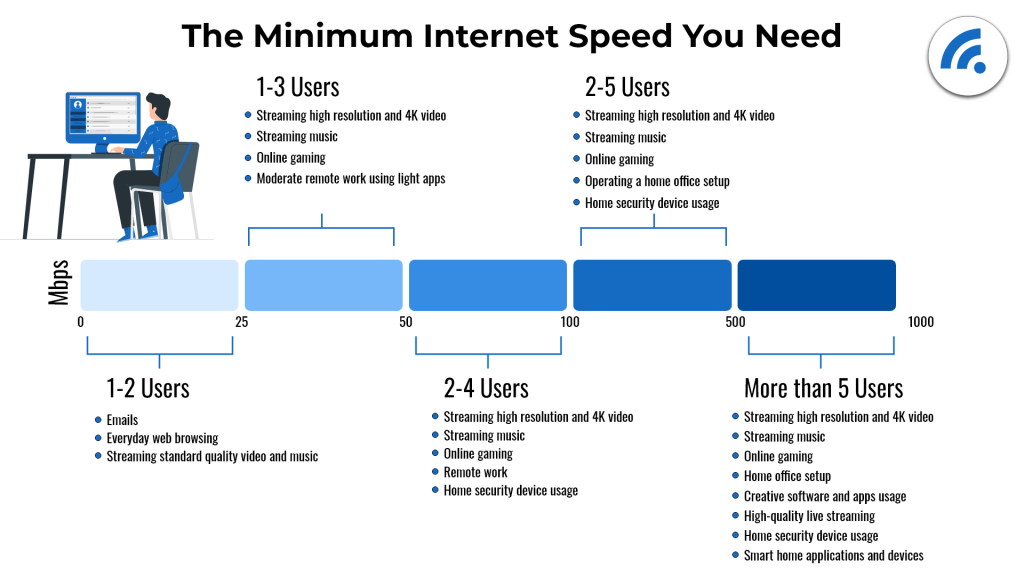
For example for a household of 5, this would be 6 x 25 Mbps or 150 Mbps service is needed. This is just a starting point. I suggest you start with the lower plan that meets your needs first and if that is not sufficient, then go up to the next plan. No vendor will ever say no to upgrading you. The following graphic from Broadband Search which summarizes “The Minimum Internet Speed You Need“.
NEXT STEPS: check with your internet service providers and size your internet plan accordingly. You may need to wait until the end of your contractual commitment to downgrade your current tier but check with them or their loyalty departments if needed. If your internet needs are modest, you might just be able to tether onto your cellular data plan.
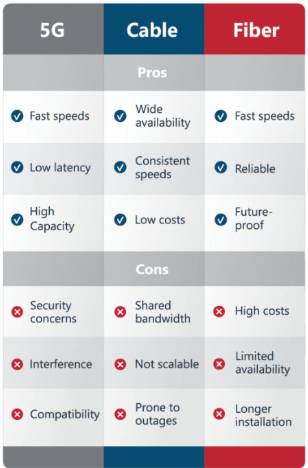
WIRELESS, CABLE OR FIBER? most internet infrastructure are “mostly” stable but service quality can depend upon your local locality. Larger urban areas may have fiber and as you move to remote areas, can range anywhere from 5G (cellular network), cable, wired (ADSL/DSL) and wired. Depending upon certain use cases Starlink might make sense,
Generally, the most reliable services goes in the following order from fiber, cable, 5G and wired services. The table from NHC summarizes the pro’s and con’s but there are always “exceptions”.
IN SUMMARY: Don’t be swayed by internet service vendor marketing as they will always steer you to the top-tier service offerings. Feel confident and start at a lower-priced tier and and if that is not suitable, simply upgrade. Hopefully that puts more savings in your pocket!
If you are not tech savvy, stick with the big 3 internet service providers (TELUS, Rogers, Bell) as they offer the best technical support. If you have a good tech support, then you can opt with a 3rd party internet services which generally have lower cost service plans.
It’s always worthwhile to request further discounts than their published service offerings. There are typically discounts for “bundled” service and also the number of years you have been a customers. Being polite will get you extra mileage in this area!
Note: if you subscribe to internet TV or surveillance, these services include free bandwidth so it not included as part of your internet service.
 55+ Tech Chat Social Group